Category: Mexico City

  • 01Jan14

    01Jan14

    ¡Feliz año nuevo! Tomorrow, we fly to Santiago.

    To bid adios to the first country in our leap year, we said farewell with tacos al pastor. Also, our Airbnb host Rodrigo stopped by with a gift of tequila and mezcal.

    We’ll spend one week in Santiago before hopping on a bus to Viña del Mar, just north of Valparaíso. Our plan is to stay for a month, and from there we’re considering renting a car and visiting places up and down Chile. It’s summer there now, so the weather will be in the mid to high 80s.

    Silver Linings Playbook and Step Brothers are queued up on our laptops, and we’ve got books downloaded onto our phones. And Holly’s got her calming treats. This is going to be a long flight for her, so we’ll see how it goes… Our flight stops over in Panama for an hour and a half, and we’ll arrive in Santiago at 5:45am local time.

    See you then!

  • 31Dec13

    31Dec13

    Announcing: Travel Tip Tuesdays!

    We thought we’d start a new tradition for the new year with a new travel tip every Tuesday. Now that we’re pros at being full-time travelers, we wanted to share the love and hopefully inspire you to do some traveling yourself!

    This week’s tip: what to do with your passport and other important documentation while traveling.

    Why does this matter? Because your passport proves your citizenship, shows when you entered a country, and is required for going home. If you lose your passport, it’s not the end of the world, but it’s a costly and bureaucratic process to get your passport replaced while abroad. It’s also a hassle if you lose other important documents, like vaccination records if you’re entering countries requiring you show proof of vaccination, or visa-related documents provided on entry.

    How do we protect our documents?

    1. Take photos. We took color photos of our passport data pages and other important documents before we left. You could scan them or use a copy machine — whatever. I recommend making one paper copy of each document.

    2. Don’t carry originals with you unless you’re actually using them that day. There are two schools of thought on this. Some say you should keep your passport on your person at all times, preferably in something secure under your clothes. I think that’s absolutely ridiculous, and don’t even get me started on things like money belts.

    While the odds of getting robbed are low, pickpocketing isn’t unheard of — as is stuff falling out of pockets or backpacks. Instead, keep the photocopy of your passport data page with you and leave the original where you’re staying. If you’re worried about staff entering your room and taking your stuff, don’t be — most people are honest. I left cash sitting out before. You can use a safe in your room if you want, but we just keep them somewhere out of sight.

    3. Save a copy in your email. We emailed copies of our documents to ourselves. That way, we’ll have copies in the cloud that we can access from anywhere if needed. You can also email a copy to relatives just in case. (We didn’t do that, though.)

    4. Pack a USB stick. Lastly, since we’ll be gone a while and really want to play it safe, we saved electronic copies of everything on a tiny USB stick. You can easily keep it on your person, or keep it tucked somewhere in your luggage like we do. That way, we can hit up an internet cafe or something to print copies if we’ve lost everything.

    Of course, all of these methods (except saving a copy in your email) are useless if you keep everything packed together! For example, Chris and I keep our originals on us while we’re flying and keep the copies in our backpacks that we check in.

    This is not a veiled warning about theft; it’s more likely that these would get misplaced than stolen. And if someone was going to steal something, it’s more likely to be the iPhone you’re messing around with on the metro! These methods will help you make sure you have backups of your passport or other important documentation if you need them.

    HAPPY NEW YEAR! Hope it’s filled with travel adventures.

  • 30Dec13

    30Dec13

    Have I mentioned that it’s stressful to bring pets across international borders? Well, it is. Today we got (almost) all the documentation we needed to bring Holly from Mexico to Chile. I say almost because we still have one more step.

    For the sake of posterity and any other person who wants to travel with their dog, here’s how to get a pet export certificate or pet health certificate in Mexico. One day I’ll write up how we got one in the U.S. too.

    / BACKGROUND / Any time you are traveling with your pet internationally — versus traveling domestically — there are special requirements. Each country has its own requirements, which may vary based on the country you’re originating from. However, most countries require some kind of official “health certificate” or “export certificate” from a government agency.

    / GETTING STARTED: WHICH AGENCIES WILL I DEAL WITH? / The first thing you should do is determine the name of the government agency you’ll be dealing with in both your country of origin and destination country. It’s usually the equivalent of the USDA, because the whole point of restricting animal importation is to protect a country’s food and livestock from harmful diseases.

    • In Mexico, the agency is SAGARPA, which is the Department of Agriculture, Livestock, Rural Development, Fisheries and Food. It has a sub-department that you will deal with primarily called SENASICA, which is the National Agro-Food Health, Safety and Quality Service.
    • In Chile, the agency is SAG, which is the Agriculture and Livestock Service.

    If you’re having trouble figuring out the agency at your destination, I recommend calling the consulate of your destination country. They may be able to offer you additional guidance, but do not trust consular workers to be up-to-date on pet travel requirements. You should get those directly from the agency. For your country of origin, just ask a local vet.

    / FIND YOUR DESTINATION COUNTRY’S REQUIREMENTS / Once you know the appropriate agency in the destination country, browse their website to find out what they specifically require. Here are the requirements to bring a dog to Chile, as of today:

    • A health certificate, in Spanish, issued by the official health authority of the country of origin that is no older than 10 calendar days.
    • The certificate must show that the pet:
      • Underwent a clinical exam by a veterinarian 10 days prior to shipment and was recognized as free of communicable and parasitic infections
      • Was vaccinated against rabies at least one month but less than 12 months prior to shipment (or was tested for rabies antibodies 3-24 months before the trip)
      • Received an internal and external antiparasitic treatment within 30 days prior to shipment, including naming the active ingredient, dosage and application date
    • The certificate must also include the name of the owner, additional background on any treatments the pet received, and the address where you will stay in Chile.
    • There is no cost to import pets.

    Be on the lookout for any special requirements for your country of origin. For example, some requirements may be more strict if you’re coming from a country that has different infectious diseases. Or, if you’re coming from a country close by, requirements might be more lax.

    Some countries, or smaller airports, may only have inspectors on hand on certain days or during certain hours. Sure, immigration and customs might be open, but there is usually a special inspector who deals specifically with animals. Since we were considering booking a flight to Santiago that arrives at 5:40am, I contacted SAG to make sure they would have inspectors on hand.

    / FIND YOUR ORIGIN COUNTRY’S PROCEDURE / Local vets are a good resource here. They may not know everything, but they can help point you in the right direction. For example, notice how Chile says “health certificate?” Well, the vet here in Mexico told us that SAGARPA/SENASICA call it an “export certificate,” or certificado de exportación.

    Unlike in the U.S., run-of-the-mill vets in Mexico don’t have access to official government forms. Rather, vets help you with your documentation, and then you pay a visit to SAGARPA/SENASICA in person with your documents to obtain your certificate. In Mexico City, that means going to the SENASICA public service window at the airport. I called their office to find out what they needed and confirmed that we only needed to bring our paperwork — not the dog. They will need to see the dog eventually though; more on that later.

    / PLAN AHEAD, BUT NOT TOO FAR AHEAD / So, you probably noticed based on Chile’s requirements that you can’t do this on a whim. Same with most countries: you typically have to have most vaccinations complete a minimum of 30 days before you leave. So make sure you get all the vaccinations you need ahead of time. Why? Like in humans, it takes a little while for vaccines to take effect in animals.

    However, don’t be too much of an early bird. Some paperwork has a firm expiration date. For example, a health certificate from a vet in Mexico is only good for five calendar days, meaning SAGARPA/SENASICA won’t give you your export certificate if the paperwork from your vet is expired. And the export certificate you obtain from SAGARPA/SENASICA can only be a maximum of 10 days old when you arrive in Chile. So, plan accordingly when scheduling vet visits and going to get your export certificate. Why the last-minute nature? An animal’s health can change quickly and there has to be a set window in which health results are considered valid.

    / TAKE YOUR DOG TO THE VET / When taking your dog to the vet to get their health certificate, DO NOT assume your vet will know a) what you need in order to get your export certificate in your origin country, or b) what your destination country’s requirements are. If you just ask them for a health certificate, they give the dog a brief physical exam and write up something on their letterhead saying the dog is healthy and disease-free, as well as confirm basic characteristics such as age, color, breed, weight, etc. That’s fine, but insufficient.

    Instead, bring your destination country’s requirements with you! For example, our vet gave us documentation specifically noting that Holly is free of parasites and that she has received internal and external antiparasitic treatment. We had to go back a second time for the latter, since we thought it would be sufficient to bring the pills with us to SAGARPA/SENASICA. Do not make this mistake. Unless it’s signed by a vet, government agencies won’t accept it. Lastly, we already had documentation from our vet in the U.S. of her rabies and other vaccinations.

    Depending on what the vet has to do, you can expect the exam and health certificate to cost approximately 300 pesos.

    / PAY A VISIT TO SAGARPA/SENASICA / Armed with our documentation, we took the metro to the airport. We ended up having to make two trips because we were missing the internal and external antiparasitic treatment documentation I mentioned above. On our second trip, we almost got sent away again because it was the last day our vet’s health certificate was valid and our trip isn’t for another couple days. It took a combination of pleading and assertiveness to get them to understand that, while the health certificate from our vet would be expired in Mexico before our trip, the exportation certificate would still be valid in Mexico and both would be valid in Chile.

    Then, there was some difficulty which our vaccination documentation because it was in English and not on a “carnet de salud,” or health card, which is what vets traditionally provide in Mexico. Basically, it’s a booklet with a pet’s vaccination and health records all in one place. Our documentation was in the form of an invoice from our vet, which listed the vaccinations received, the dates, Holly’s patient information, the cost, and included the vet’s signature.

    But the man told me that the information needed to be in a carnet de salud and that he could not accept this, even though it specifically said Holly got a rabies vaccination on September 7. I pointed this out to him and he told me that it didn’t have the signature of the vet who gave us our health certificate. I pointed to the signature from the vet in the U.S. who gave the vaccination. He finally acquiesced. Remember, bureaucracies are the same all around the world. Be patient and assertive.

    We handed over copies of all of our documentation and walked away with our export certificate. We celebrated with coffee and Cinnabon at the airport. We just have to bring Holly in person before our flight — so we have to arrive even earlier — for a final check and another signature on the certificate before we can leave.

    The flyer on the wall said that export certificates cost 421 pesos, but we were not charged anything. However, it’s possible we’ll have to pay that when we come back for the second signature.

    / OTHER TIPS / Here are a few additional tips:

    • It really helps to know some Spanish. My Spanish has improved wildly since being in Mexico, and I was able to have fairly complex conversations with both vets and government officials, in person and by phone. If your Spanish isn’t that good, make sure to ask people to speak slowly and repeat back what you think you heard them say to make sure there are no miscommunications.
    • Make copies. Make two or three copies of all your documentation, and never give away your originals. Do not expect government agencies to make copies for you — they will send you somewhere where you can pay to make them yourself.
    • Don’t assume. It’s up to you to know what the requirements are and make sure you have what you need. Ask lots of questions. Tell people exactly what you’re going to do and ask them if they see any problems; don’t expect them to offer the information proactively.
    • Check your airline’s requirements too. Chances are, if you’re meeting your destination country’s requirements, you’ll be fine with your airline. But check with them too in case they have any special requirements before allowing you and your pet to board.
    • Be your own advocate. If you’re not getting what you need, show documentation and ask again. If you’re not confident you’re getting the right information, get a second opinion. You have to be assertive!

    Oh, the things we do for this girl. We love you, Holly.

  • 29Dec13

    29Dec13

    One of the best things about Mexico City is the food. And as I mentioned in previous posts, you can get great food for cheap while traveling full time.

    In fact, some of the best food we’ve had has come from small, no-name places around the neighborhood rather than big restaurants.

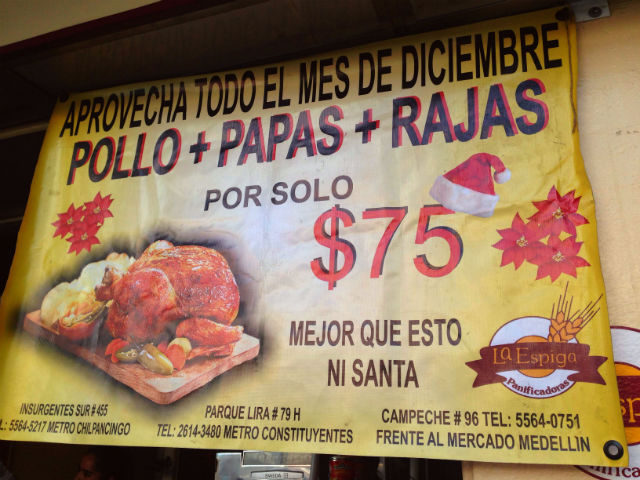
    Take this bakery across from Mercado Medellin called La Espiga. Not only do they make fresh and delicious breads and pan dulce (pictured above), but they also have these amazing rotisserie chickens that you can buy for super cheap.


    Buying chicken in Mexico City


    We didn’t find it in a guidebook; we found it just walking around. Walk a few doors down and you can get a quarter kilo of tortillas for 3 pesos. Walk across the street and you can get quesadillas or tortas or tlacoyos.

    Chris recently read an article about the best food cities in the world, and here’s what one writer said about food in Mexico City:

    Mexico City and Tokyo are still my favorite dining destinations. Both cities are endless urban sprawls of street food interspersed with great restaurants. The bar is set very high in these cities, as food is fundamental to both Japanese and Mexican cultures. There is an emphasis on simplicity and depth of flavor rather than novelty or style. Competition is fierce, so restaurants and vendors that don’t serve great food are quickly replaced. Both of these cultures truly respect food as a lifelong craft. The taquero shaving pork off the rotating spit in Mexico City has probably been doing it for decades, as has the ramen chef in the streets of Tokyo.

    Anyway, we should probably work on an article about how not to get fat while traveling. If you have any advice for us, let us know. 🙂

  • 28Dec13

    28Dec13

    We went full-on tourist and followed some Lonely Planet recommendations. The main event was Plaza Garibaldi, where mariachi bands roam and which Lonely Planet describes as “notoriously seedy” but is also the recipient of “a recent makeover.” They also call it one of their top choices when visiting Mexico City, so we decided to make a night of it.

    Here’s a quick video so you can take it in:


    It’s a couple blocks away from the Garibaldi metro station and near a big food mercado, which is where we decided to have dinner. It’s a long hallway with probably 20-25 small restaurants that all looked good. We picked one and some other gringos saw us and decided to follow suit. If they only knew, we have no idea what we’re doing either.

    All around the plaza there are restaurants and bars too, although I suspect they’re expensive. That’s also where the Museum of Tequila and Mezcal is — and it’s open very late — but we couldn’t bring ourselves to do it and preferred to just have a seat in the plaza.

    Anyhow, we got wrangled into buying a few songs, and I even got a dance with the guitarist. If we could do it again, we would have been firmer about the number of songs — they’re not cheap! 80 pesos each — but there were six guys and when are we ever going to do this again.

    Keeping with the tourist theme, we ate at El Hidalguense for lunch where we saw many other gringos. We saw more gringos today than during our entire month here! The food was good — they’re known for their barbacoa. But the real highlight was I got a much better recording of my favorite amplified announcer woman as the truck drove by the restaurant.


    We’ll miss hearing her voice!


  • 27Dec13

    27Dec13

    Time for a blog about cultural norms. People love making out in public here. Not a sweet, prolonged kiss. I’m talking hardcore, hands-barely-over-the-clothes making out.

    My lovely friend Nicole gave us a heads up that we’d see a lot of this through our Latin American travels, since she did as well. And since she is Bolivian, I take her explanation seriously: everybody lives with their families, so the only place to make out is at the park. Or sitting next to me at a taqueria.


    People making out in Chapultepec Park Mexico City


    I can understand the teenagers, but there are 30- and 40-somethings too. Ah, to grow up without Puritan influence. I snapped these photos while Chris and I were riding bikes through the park. Pretty sneaky, huh? Or maybe just pervy.


    Bike riding Mexico City Chapultepec Park


    At this time next week, we’ll be en route to Chile — unless we bump up against any issues with Holly’s paperwork. The vet and I were commiserating about how terrible the website is for Mexico’s agricultural/wildlife agency. Thankfully, he was very helpful. Fingers crossed.


  • 26Dec13

    26Dec13

    Today is Holly’s quinceañera! We love this girl so much that we only subjected her to this purple rhinestone bow. Plus she prefers understated and classy. And we made up for the embarrassment with a present.


    dog quinceañera


    Depending on what you formula you subscribe to, Holly is anywhere from 75 to 105 in human years. Wow! And she’s still lively as ever:


    Happy birthday, pretty girl. I hope we’re giving you a happy life!


  • 25Dec13

    25Dec13

    ¡Feliz Navidad! We miss you all and hope you’re enjoying the holidays. Doesn’t Chris’s beard look awesome?

    Two hot life tips for you:

    1. Go see The Secret Life of Walter Mitty!!!
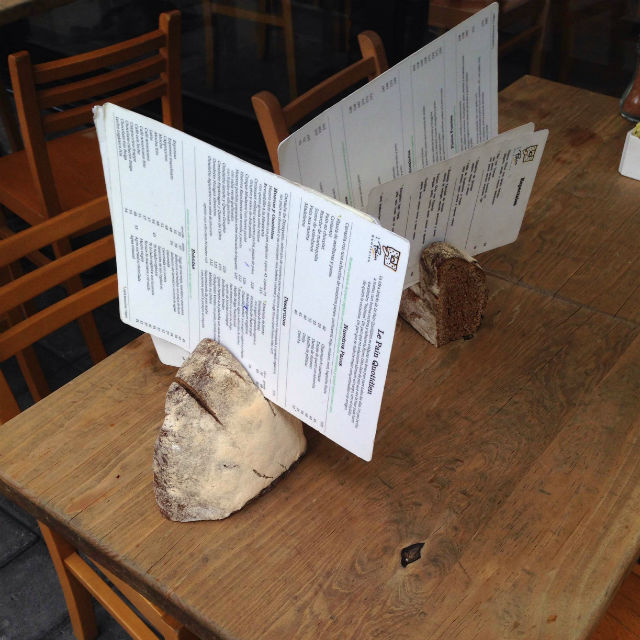
    2. Turn that leftover stale bread into something useful, like so:


    Bread menu holder


  • 24Dec13

    24Dec13

    These chiles have lots of Christmas spirit. It’s very quiet in the city right now, except if you stray too close to Sears or Woolworth. Kind of like when you’re in San Francisco over Christmas.

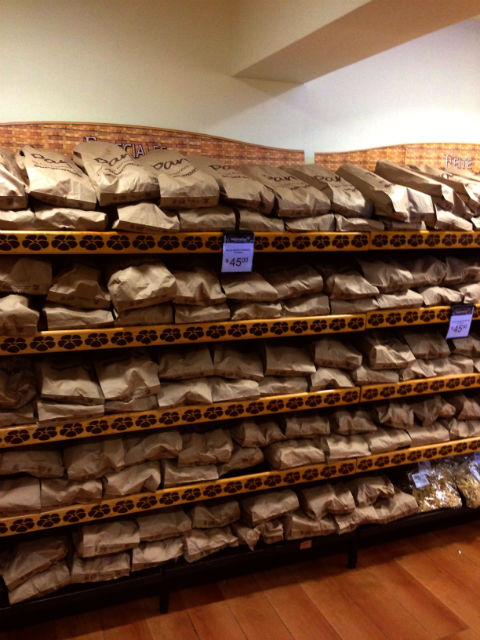
    The supermarket nearby cleared all the shelves in their bakery to sell packs of baguettes — three to a bag. There are three more walls of these!


    Christmas time bread in Mexico City


    One of the things we love about Mexico City are the vendors who ride up and down the streets, usually selling pan dulce. Sometimes they’ll have a bell or call out “tamales!” Sometimes they’ll play a recording, like this one. Can you tell what she’s saying? (Make sure your volume is turned up so you can hear until the end — the truck was driving faster than I could walk!)


    I love her sing-songy cadence. We always hear but we could never quite understand what she’s saying, until our neighbor told us: they buy used stoves, microwaves, mattresses, washing machines, etc. “Te compra…colchones…”


  • 23Dec13

    23Dec13

    This photo isn’t exactly tasteful, but it’s the only one I took today. And why wouldn’t I snap this photo? What dog chooses the most confined space possible to pee? Holly, the girl just three days away from her quinceañera. What a crazy old dog. We love her.

    This is also the only photo we took because we’re suffering from a little bit of travel fatigue, I think. Maybe we’re ready for the next leg of our journey, maybe it’s tough being away from home during the holidays, maybe we’re ready to be feeling healthier. To top it off, we had some horrible, horrible sushi tonight at the restaurant at the bottom of our building. It’s always so busy, we thought it would be good. Instead, one word: mayonnaise.

    We still have a week and a half here in Mexico City, and I’m glad we stayed here this long despite our complaints about the pollution. The Professional Hobo wrote a blog post about why she loves slow travel and I wholeheartedly agree with it.

    There’s a moment you reach where you no longer feel someplace foreign — you’re just where you are. Chris and I were laughing the other day while walking down the street, because sometimes we forget we’re in Mexico. It’s a weird but cool feeling.

    So with that, here are the remaining things on our Mexico City do list: